

Charting DeKalb’s Economic Future: A Q&A with KB Advisory Group on the County’s Strategic Economic Development Plan
DeKalb County, Georgia, is at a pivotal moment in its economic development journey. With new leadership, emerging opportunities, and a rapidly evolving regional landscape, Decide DeKalb Development Authority is updating its Strategic Economic Development Plan (SEDP) to position itself for future growth. The SEDP will help guide us as we attract high-quality investment, new businesses, and jobs to DeKalb County and increase the quality of life for all residents.
We sat down with Geoff Koski, President, and Tate Wilson, Director at KB Advisory Group, the consulting firm leading this comprehensive planning process, to discuss what makes DeKalb unique, the challenges ahead, and how this plan will shape the county’s economic future. The transcript has been edited for length and clarity.
Tell us about KB Advisory Group and how you came to work with Decide DeKalb on this strategic plan.
Koski: Our work in the region typically revolves around real estate and economic development. Most of our clients are cities and counties across Georgia, so this is right up our alley. We’ve worked with Decide DeKalb in the past, helping them set up two tax allocation districts and writing the redevelopment plans for those TADs. We had a good working relationship with them, and they knew us professionally.
We’re the lead consultant, but we also have national experience on our team. We have Urban Pulse, led by Christopher Pike, who has been an economic development director in South Fulton, giving us that boots-on-the-ground, practitioner experience. We also have Wilson with Molly McKay out of Washington D.C., offering national case studies for DeKalb to learn from, and Kevin Johns, former economic development director of Austin, Texas,
This is an update to the existing strategic economic development plan. What prompted the need for this update?
Koski: It’s fairly common for a plan like this to be on an update cycle, typically every five years, similar to a comprehensive plan for a city. The last one was completed in 2020, so it was time for review. But obviously, a lot has changed since 2020. They were actually in the middle of updating the previous plan when the pandemic hit.
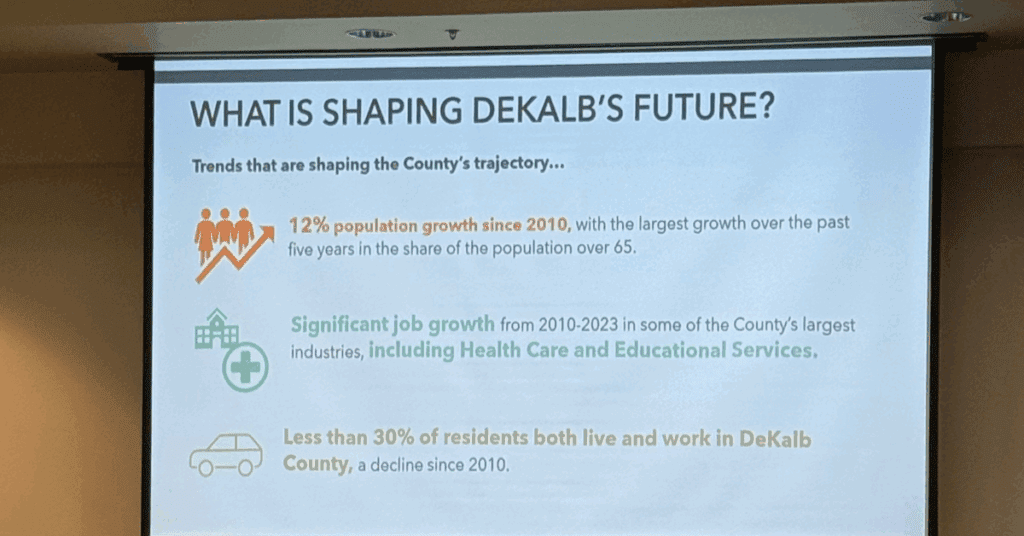
Wilson: We’re taking stock of what’s changed demographically, economically, and within the real estate markets, both in DeKalb County and the region overall. There are some demographic trends where DeKalb may be lagging behind the pace of growth in the metro area, which is a concern. We’re also revisiting target industries, especially considering post-pandemic changes like supply chain issues and the growth of industrial development, where DeKalb may not be positioned as well as more suburban counties with greater land availability.
The office market in DeKalb is really centered in North DeKalb, around Perimeter, and we’re seeing turnover in office tenants. We’re looking at what tools exist, both monetary and relationship incentives, to retain existing tenants and welcome new ones. Additionally, with institutions like Children’s Healthcare of Atlanta that opened last year, there’s a big opportunity to leverage the relationship between healthcare and educational institutions, from Agnes Scott and Oglethorpe to Mercer and Emory.
What makes DeKalb County unique from an economic development perspective?
Wilson: DeKalb means a lot of things to a lot of people. From a residence standpoint, they think about quality of parks and trails, quality of schools. Is this a place where I want to live? DeKalb has historically been more of a bedroom county, where you didn’t have large office cores or concentration of jobs. We’ve seen that begin to shift.
It’s this residential beacon that’s close to Atlanta, close to job centers. You can’t disregard the transportation networks, with I-285 and I-20 running through DeKalb, which supports distribution and industrial uses. You also have MARTA, so communities north and east of Decatur can easily get into Atlanta’s urban core and job centers. DeKalb is still recognized as a great place to live but maybe hasn’t been as boastful about what a great place it is to work. That’s something we’re trying to reconcile in more of a branding strategy.
Koski: When we do these strategic plans, a lot of it is technical and data-driven, like understanding the real estate market, target industry analysis, economic data, supply chain data. But we also focus heavily on quality-of-life issues as part of economic development. Making a county a desirable place to live and spend time will be attractive to companies looking to locate or stay. The more they see better quality of life, higher quality of life, more diverse quality of life, the more it adds to economic attractiveness.
Decide DeKalb has a role in that, but it takes partnerships. There are great partners, great firms, cities, agencies across the county and region, that are key to creating this quality of life through partnerships with Decide DeKalb.
Walk us through the process of developing this strategic plan. What are the key phases and milestones?
Wilson: It’s a longer process with a lot of input throughout. We start with understanding who we need input from, beginning with a steering committee that includes CIDs, schools, the Decide DeKalb board, and key partners within DeKalb County. This guides our focus groups. We’ve already met with all the CIDs within DeKalb County and all the economic development managers of the municipalities.
We conducted two surveys in multiple languages: a residents survey focused on people who live in DeKalb County, asking what they’re looking for and what makes DeKalb unique from their perspective; and a business survey, targeting the needs of businesses today and obstacles they foresee in the future.
We do what we call level-setting from the get-go – demographic, economic, and real estate profiles that look at change over time on key trends. We call these our baselines: a people baseline, a business baseline, and a built environment baseline. From there, we conduct our target industries analysis, which leads to our implementation plan.
We have one-on-one interviews with key partners like Metro Chamber, Georgia Power, key employers, and all the DeKalb County commissioners, including the new CEO. This gets us to a consensus workshop where we present the plan and ask for agreement on the game plan and everyone’s role in it. That happens at the end of summer when our surveys wrap up.
Finally, we have our economic development summit, which serves to introduce the plan and garner champions, but also gives Decide DeKalb an opportunity to show where their thinking is and focus on specific, timely issues.
Why is public input so important in shaping this plan?
Koski: We use the term “ground truthing” to highlight what we’re doing with community input. It’s such a data-intensive process. We’re looking at a lot of numbers about DeKalb County, but we need to ground truth that data. We ask the community: does this data and these conclusions feel like they represent your life, your work in DeKalb?
If we only crunched data sitting at our desks, we’d be missing so much about how the county works. The public input process for an economic development strategic plan is different from a comprehensive plan. It’s more technical and specific to job attraction and retention. We want to hear from firms of all sizes, from single-member firms to 1,000-person firms, from white-collar to blue-collar jobs.
It’s also important geographically. The conversation around the Perimeter area, where key office nodes are located, is very different from what’s happening around Bouldercrest, where transportation, logistics, and movie filming occur. Both are very important to the economy, but they’re very different conversations. We need to understand economic diversity across the entire county.
How do you define “high quality investment,” and what sectors are you targeting?
Wilson: Usually we’re talking about wages, but it’s also important to attract stability. We think about high-quality jobs in both ways – high-paying and stable. During the target industries analysis, there are some sectors we questioned whether they deserve significant investment of time and resources.
In economic development, you’re either investing monetarily or with your staff’s time in efforts to attract what might not come or retain what might leave. Some things don’t need help to locate in DeKalb; others need a lot of help. Film is a good example. Although it’s controlled statewide, the industry is dependent on tax credits, so there’s not much a county can do beyond what the state offers.
One issue DeKalb faces in attracting higher-paying jobs is its dependence on one office core. To have these higher-paying jobs in tech or finance, you need solid office cores and the right product. That’s where incentives for private industry to build [real estate] product in DeKalb come in, and where redevelopment efforts become important.
Koski: This plan is about prioritizing for DeKalb County: what jobs to go after, what sites should be aggressively developed? A quality job doesn’t necessarily have to be the highest-paying job. Not everyone in the county is qualified for the highest-paying job. It’s about getting the best bang for your buck given the county’s workforce. A quality job in one sector may be different than what’s considered quality in another sector, but they’re both quality jobs for the county because they’re intended to be available for county citizens.
What strategies are most effective for bringing new businesses to DeKalb?
Wilson: Sometimes it’s site-specific: do you have available land, existing office space, potential for future campus development? It’s about marketing yourself and staying up to date on what’s happening regionally. Is somebody in another county moving, and should DeKalb be on the lookout to capture them and keep them in the region? Decide DeKalb staff is really plugged into those conversations.
Then there’s positioning your incentives: what does Decide DeKalb have to offer? There are plenty of tools, like brownfields programs, TADs, and potential for redevelopment funds. It’s about how they’re marketing and taking those tools to attract what they want to see.
Koski: Attracting jobs is about understanding who you are, playing to your strengths, and creating partnerships to get those strengths across to potential employers. It’s knowing yourself, developing partnerships, and having the right tools or incentives, but also the intangibles like quality of life. What is it about the community that’s attractive to employers? It’s usually a monetary decision, but it’s also having a story to tell about why this is a quality community for jobs and workers.
How do you balance economic growth with maintaining quality of life for existing residents?
Koski: There’s a saying in economic development: if you’re not growing, you’re dying. Without progress, a community withers away. The option to do nothing isn’t really an option. Change is happening. A responsible economic development team like Decide DeKalb has the ability to understand what’s going to be good for the community in terms of quality growth.
It can be a tricky conversation, particularly in a fast-growing region like Atlanta. People often feel exasperated by change, but folks like progress. It’s hard to have one without the other. Understanding your constituents and having a plan helps you know who they are, what they’re interested in, and where strengths and weaknesses lie.
Wilson: We’ve been asking the community to define quality of life for themselves. We’re hearing a lot about schools, recreation, transportation, affordable housing, and the ability to maintain housing stability. Decide DeKalb can influence some of these directly, but in other areas, they need to partner to deliver.
Something Decide DeKalb maybe struggles with is bragging about what they’ve accomplished. People might wonder how a development authority affects school quality, but school quality might be a deciding factor for a business looking to stay or move to the county. We’re having conversations about how Decide DeKalb can be better cross-collaborators with actors responsible for key metrics by which the county is judged.
What role do small businesses and entrepreneurship play in your strategy?
Koski: It’s huge. Something like 70% of all businesses in the region are small entrepreneurial firms, from one-person consulting shops to contractors and everything in between. It’s important that the plan focuses on understanding the needs and desires of entrepreneurs and making this a positive business environment for them.
The big firms and economic development wins get the headlines, like home runs in baseball. But really, it’s the teams that hit singles and doubles that sustain themselves over time and don’t strike out as much. If you focus on small ball, you can limit strikeouts and add up the wins. It takes longer to get to 1,000 jobs, but these are jobs that will stick.
Entrepreneurship is everything to an economy. This plan has to address that while also addressing the desire to bring in big firms and major capital investment. It’s not either/or. It’s both.
What are the biggest challenges DeKalb faces in economic development?
Koski: One challenge is land availability, and even when there is land, is it the right kind? If we’re talking about bringing in large industrial users or creating new campuses, there isn’t a lot of available land for that. Economic developers have told us that basically, if you see Stone Mountain sticking out of the ground, [the other] half of the county has Stone Mountain just underneath the dirt. Many parts of the county are very difficult to develop [because of the granite underneath].
But DeKalb’s diversity is really one of its strengths. It’s full of a workforce able to pick up jobs at all ends of the spectrum, people qualified for just about any jobs you would bring. The workforce diversity is part of the county’s biggest strengths. The diversity isn’t just in people, but also in the types of environments where jobs can locate, from Class A office and mixed-use environments around Perimeter to logistics around Bouldercrest.
Right now, there’s real optimism in DeKalb. I’ve lived in DeKalb for 25 years, and I’ve never seen this type of optimism. A lot revolves around the energy the new CEO has brought. She’s focused on fixing essentials like water, which is huge for economic development. Having quality, dependable water is so important if jobs are going to show up. She’s laser-focused on getting that fixed, and she’s assembled a good team with her priorities straight. That’s created optimism that’s become one of DeKalb’s calling cards.
Looking ahead, what does success look like for this plan?
Wilson: This is a timely, important plan. Decide DeKalb is doing it at the right time. In these tumultuous times in private markets and public funding, with a questionable outlook on revenues, this planning gives DeKalb the opportunity to re-emerge with a new reputation.
As a DeKalb resident myself, I believe DeKalb has a lot of potential energy it’s waiting to unlock. These are the years of planning that will allow the county to do that.
Koski: We live in the Atlanta region where growth is coming. People want to live in Atlanta, and they’re going to continue to come. We’re competing with some of the fastest-growing regions in the nation. How does DeKalb capture its fair share? This plan is intended to position DeKalb to capture that share by setting priorities. Given that the region is growing and will continue to grow, this plan and Decide DeKalb’s actions should set up the county to capture its fair share.
Learn more about our initiatives and how you can get involved at Decide DeKalb Development Authority.